
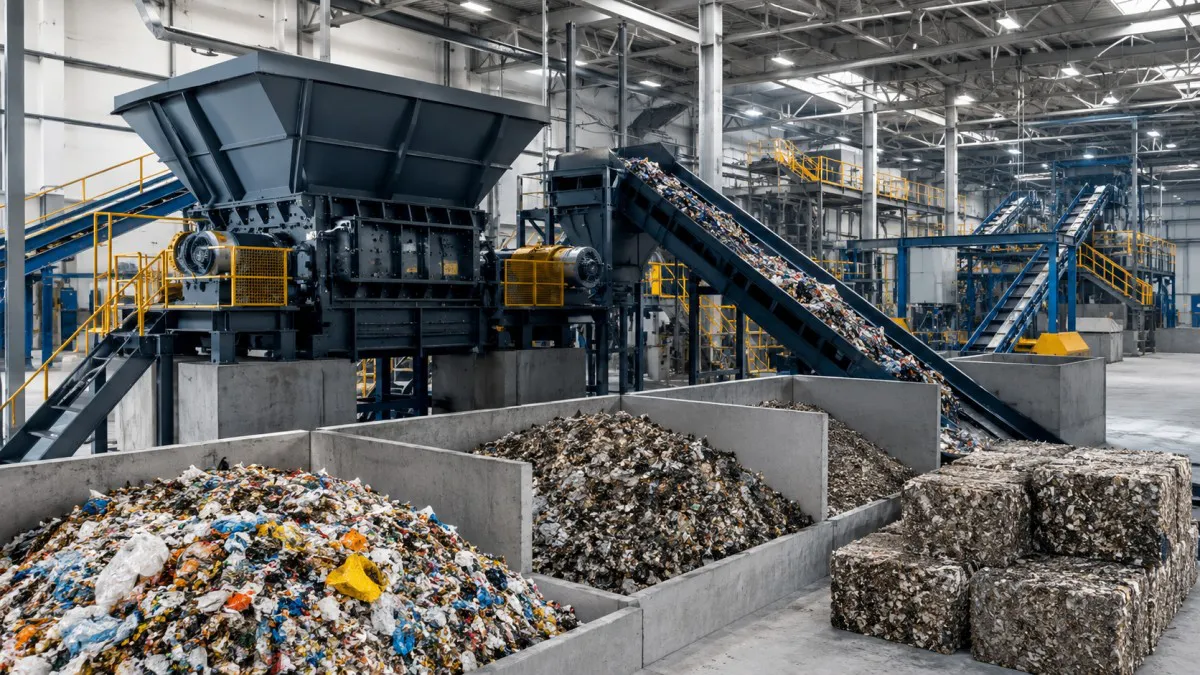
Refuse-derived fuel and solid recovered fuel are produced from selected combustible waste. Typical materials include plastic, paper, textiles, wood and other fractions that cannot be recycled economically through conventional methods. Before these materials can be used as fuel, they must be processed into a stable and suitable form.
Industrial shredders play a central role in this process. Incoming waste is often large, mixed and inconsistent. Bags, packaging, wood, textiles and plastic products may arrive in the same load. Primary shredding opens the material, reduces its size and makes it easier to separate.
After the first shredding stage, magnetic separators can remove ferrous metals. Air separators, screens and manual sorting stations may then separate heavy materials, fines and non-combustible components. The remaining high-calorific fraction can be shredded again to achieve the required particle size.
The correct discharge size depends on the final user. Cement kilns, power plants and industrial boilers may have different feeding systems and fuel specifications. A line producing coarse RDF will not require the same machine configuration as a system producing a more uniform SRF product.
Moisture content is another key consideration. Wet waste can reduce fuel quality and may also affect feeding behaviour. Sticky material can build up inside hoppers and conveyors, while lightweight dry material can create dust. The shredding line should therefore be designed with suitable feeding, dust control and fire protection systems.
A single-shaft shredder is often used for controlled secondary shredding because the screen can help regulate output size. A double-shaft shredder may be installed at the primary stage to handle large and irregular waste. In many projects, both machine types are used in sequence.
Energy consumption should be evaluated across the entire line. Producing a smaller particle size usually requires more power and creates more wear. It is not always economical to shred the material finer than the final process requires. The target size should be agreed with the fuel user before equipment selection.
Stable fuel production depends on more than one machine. Feeding, separation, shredding, storage and quality control must work together. When the system is correctly designed, shredders help turn difficult waste into a more uniform material that is easier to transport, store and use.
For RDF and SRF projects, the most successful lines are usually those built around real waste samples and clear fuel specifications. Equipment should be selected after testing the material, not only from a general process diagram.